Did the Sky Explode Over Mesopotamia in 2350 BC?
At Tell Brak, Marie-Agnès Courty traced a layer of burned soil and glassy debris to about 2350 BC. A Louisiana discovery offers a way to test what made it.
Sixteen years ago, I posted Marie-Agnès Courty’s account of the 2350 BC Middle East anomaly here on the Tusk. I called it an “Oldie but Goodie.” I undersold it. A French soil scientist had gone looking for the story of a fallen empire and come back with a question I still want answered. What happened over northern Syria that left the ground burned and littered with microscopic debris around 2350 BC?
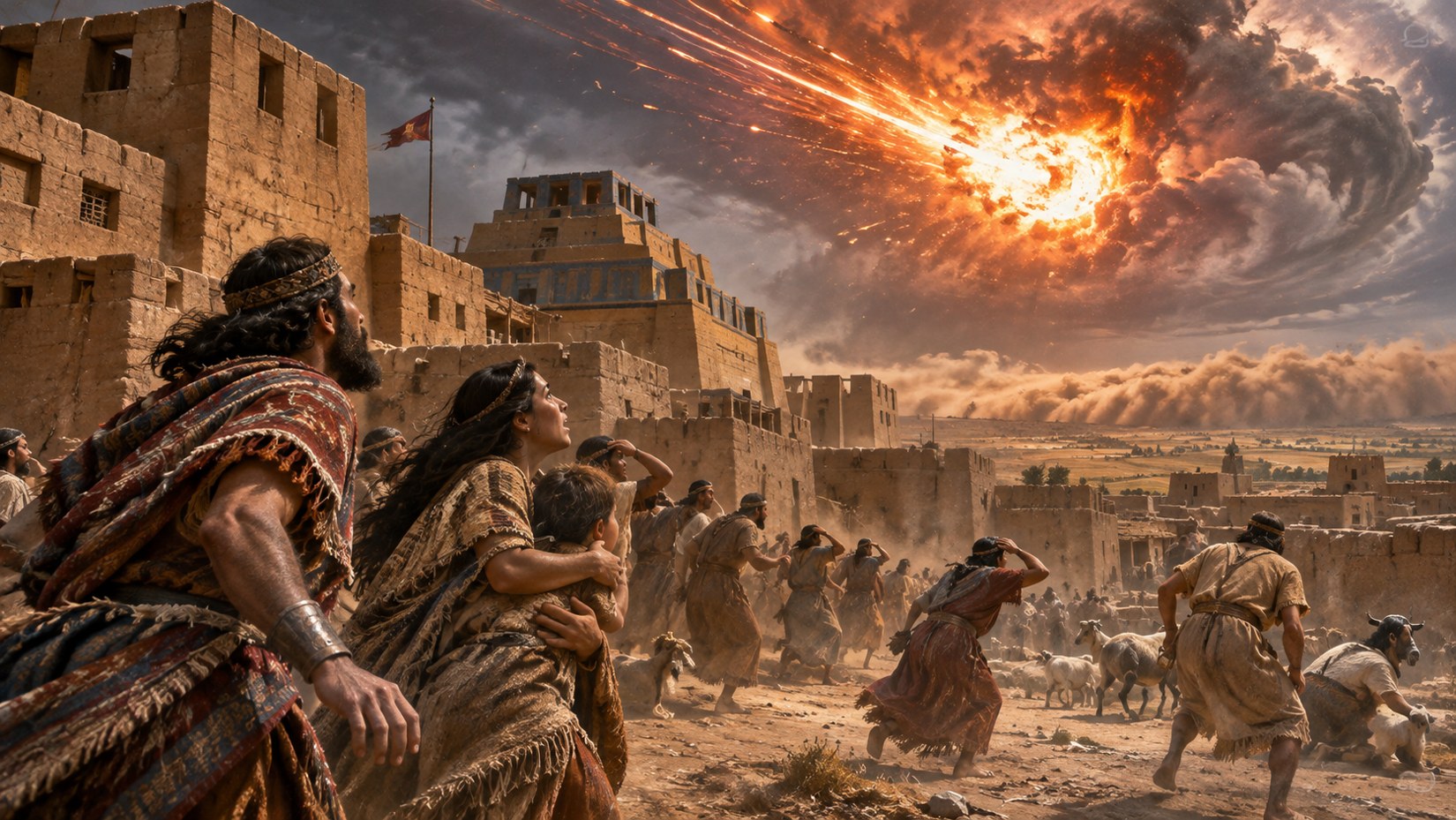
I think the Bronze Age Middle East experienced cosmic impacts, including airbursts, and I think Courty found evidence of one. What earns her a place on the Tusk is how she arrived at that idea. She helped write the conventional explanation. Then she took another look at the dirt.
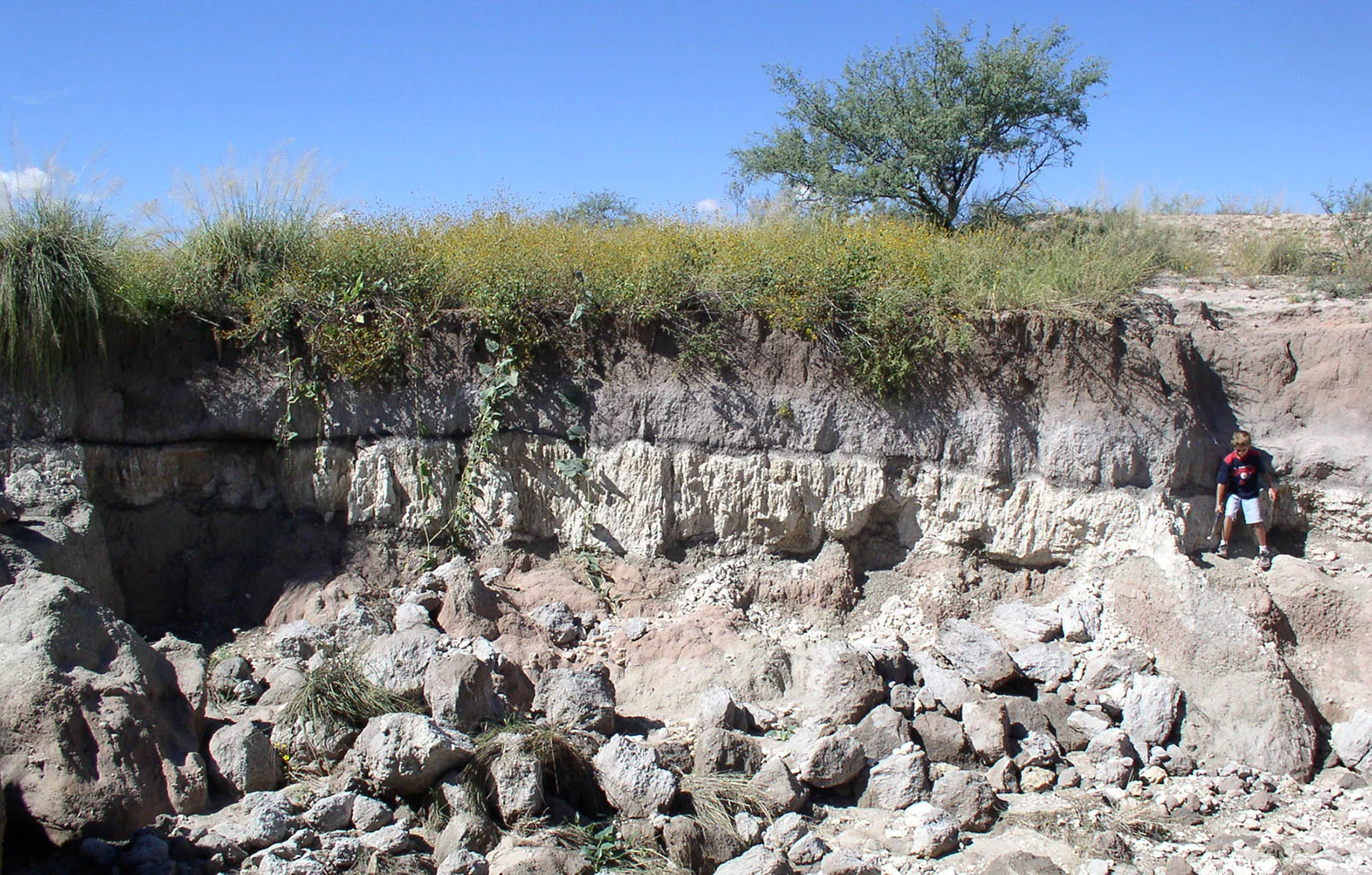
Where the evidence was found
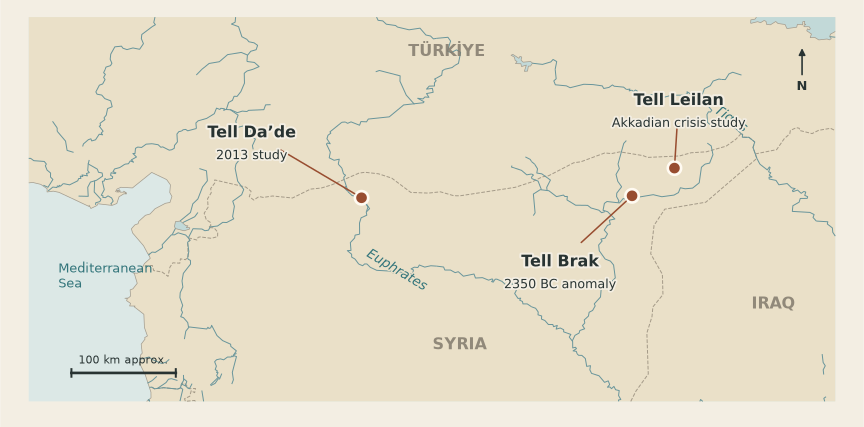
In 1993, Courty was a co-author of the Science paper that linked the abandonment of Tell Leilan and the Akkadian collapse to a severe climatic disruption around 2200 BC. A volcanic eruption figured in the proposed sequence. But at Tell Brak, the troublesome layer lay beneath a monumental building associated with the Akkadian king Naram-Sin. The empire still had enough life in it to put up that building after the debris came down. Courty put the disturbance around 2350 BC, roughly a century and a half too early to deliver the empire’s death blow. Courty’s account of the Tell Brak evidence
The chronology problem

That correction cost her a tidy historical explanation. It did nothing to explain the particles. In thin sections of soil, Courty saw rounded grains of silica and calcite, dark porous fragments with minerals caught inside them, and the remains of a burned surface. She questioned whether ordinary volcanic fallout could account for the way the material lay on the ground.
The clues in the soil

Here is the part I should have emphasized in 2010. By 2008, Courty and seven colleagues had compared material from Syria, Spain, France and Peru. Their chapter put the idea of a cosmic origin to the test in the grains themselves. Look at Figure 6 on page 220. A silica-rich droplet from Syria, glass from Spain, a carbon-rich sphere from Peru. The team argued that impact debris could account for the unusual assemblage. In 2013, Courty and Eric Coqueugniot went back into the archaeological record at Tell Dja’de and explicitly engaged with our Younger Dryas research. Whatever one makes of her conclusions, there is little mystery about her determination. She kept looking for the fingerprints of cosmic events.
Read the paper · scroll inside the window
A different record of environmental stress

I wonder how much the prevailing view shaped what happened next. Give an archaeologist a drought coinciding with the abandonment of a farming settlement and the next question comes naturally. What happened to the crops? Give that same archaeologist a burned surface scattered with glass and suggest an explosion overhead. How many people get as far as asking who still has the samples? Mainstream opinion can exert its influence right there, in the choice of which question gets another field season. That’s my reading of the problem. Courty can speak for herself, and her publication record speaks pretty clearly.
I have a stake in this. I co-authored the 2021 Scientific Reports paper arguing that an airburst destroyed Tall el-Hammam in the Jordan Valley around 1650 BC, some seven centuries after Courty’s Syrian event. The journal retracted our paper in 2025, citing objections to the mineral evidence and the comparison with Tunguska. Readers can weigh the original paper and the editors’ reasons. My own view remains that the sky belongs in the history of the Bronze Age Middle East.
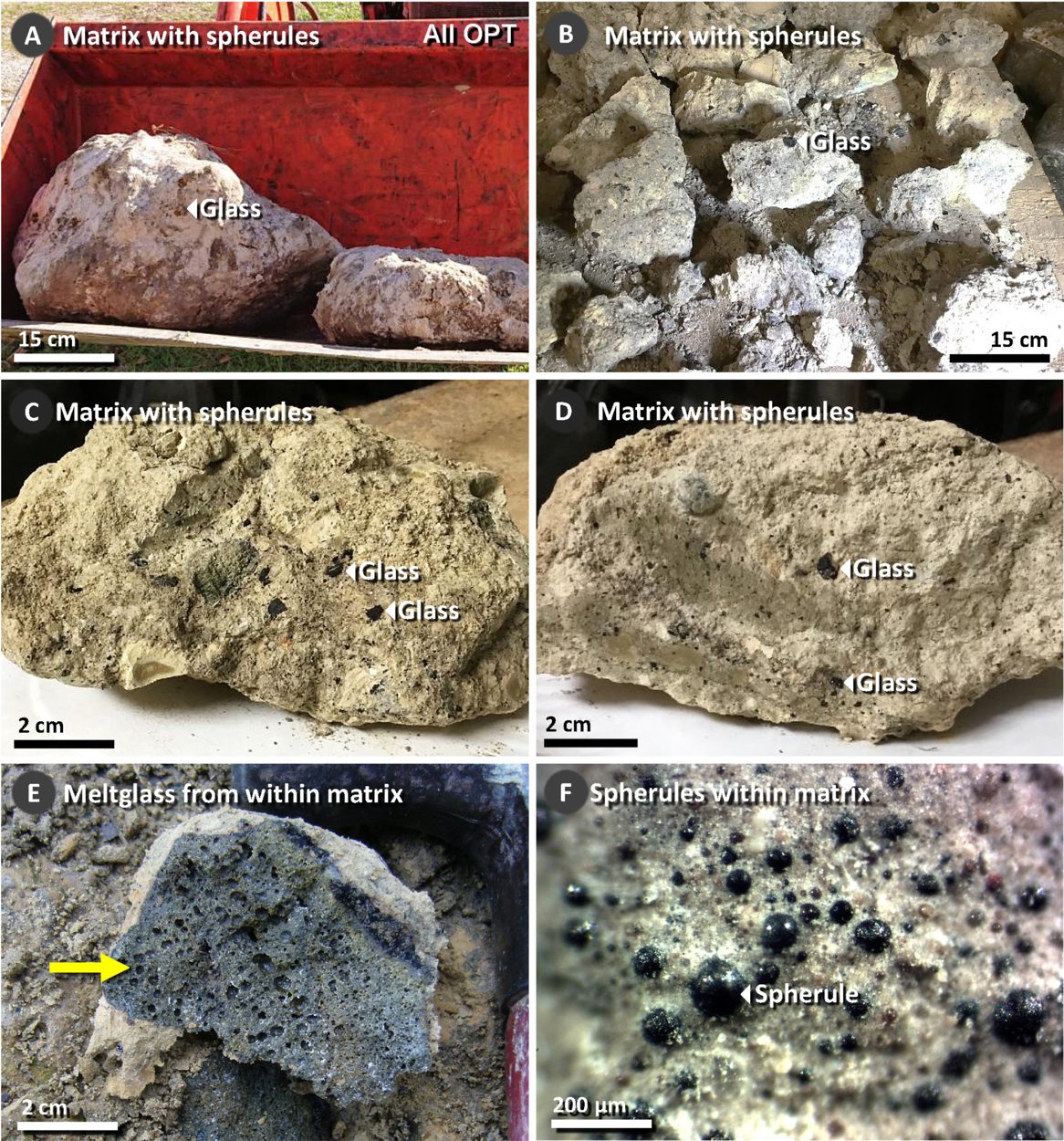
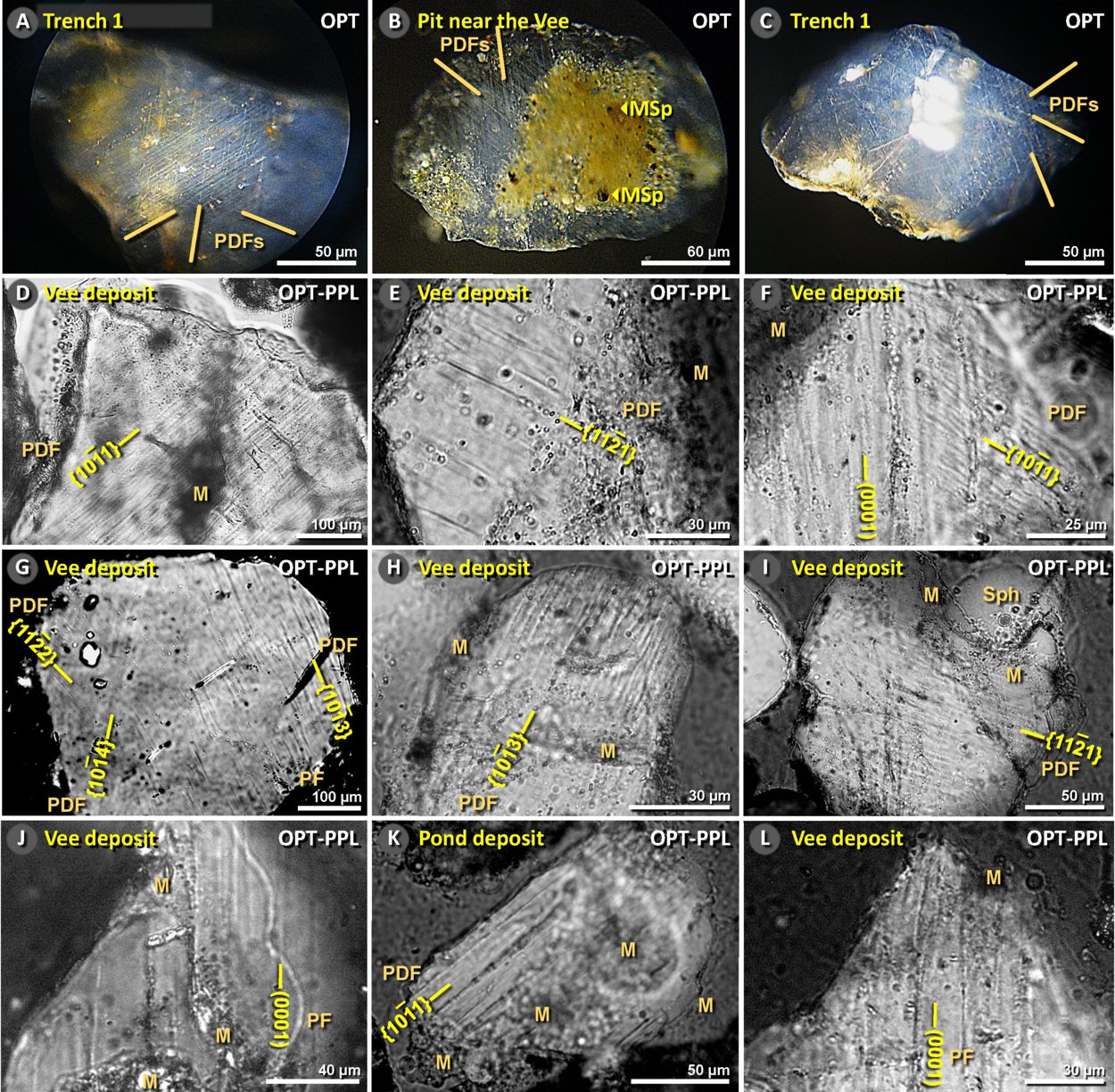
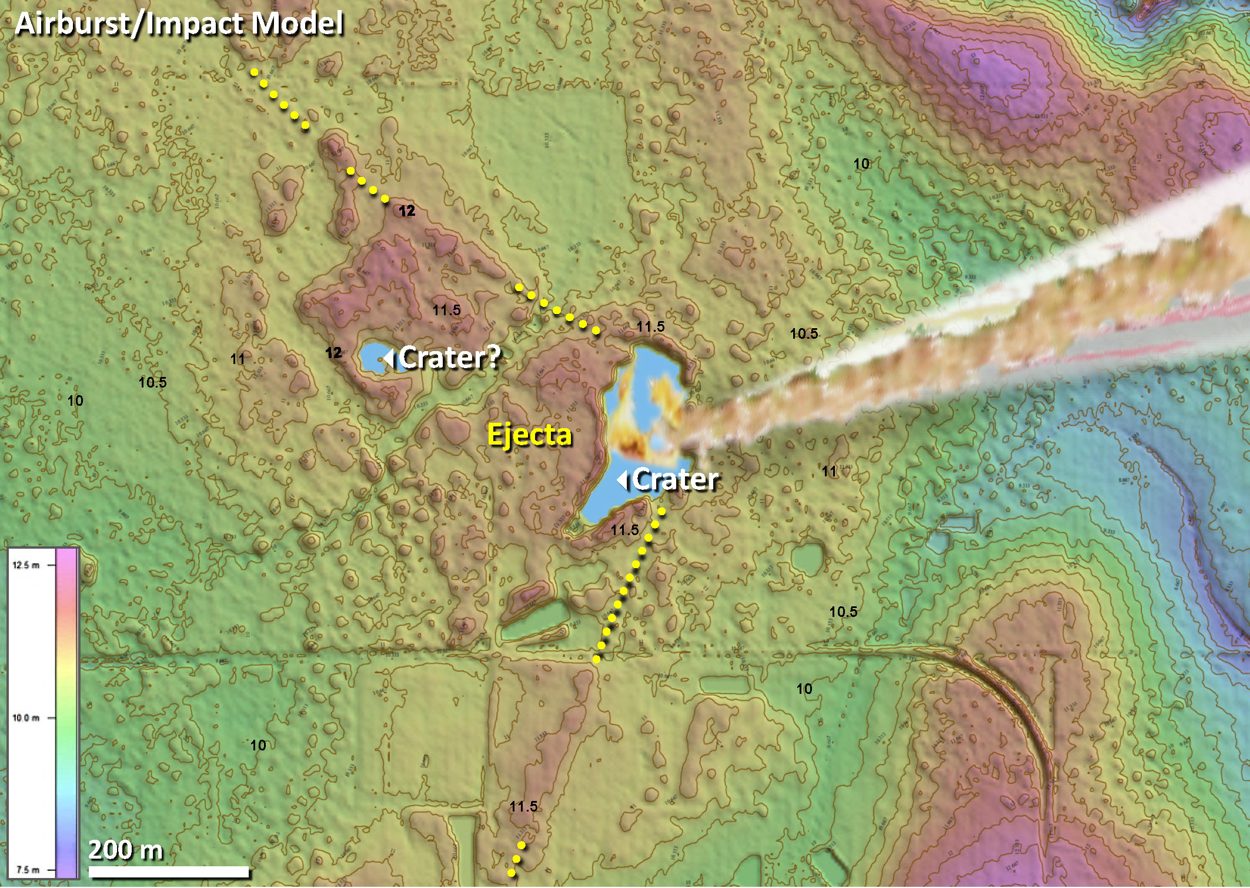
Which brings me, by way of northern Syria, to Perkins, Louisiana. There, members of the Younger Dryas team reported spherules and meltglass at a shallow depression, along with something I’d particularly like to look for in Courty’s samples. In Figure 23 of the Perkins paper, you can see the sets of planes the investigators measured inside individual quartz grains and interpreted as evidence of shock. That gives us a specific comparison to make across two sites separated by an ocean and more than eight thousand years.
Meltglass and spherules
Read the paper · scroll inside the window
Quartz under shock
An airburst scenario
If I could ask Courty one question today, it would be a practical one. Where are the original Tell Brak samples? I’d like to see those grains on the same laboratory bench as the Perkins material, alongside samples from volcanic deposits and ancient furnaces, with the labels covered. Courty spent years asking whether something had come out of the Bronze Age sky. Sixteen years after I first put her work on the Tusk, I’d still put my money on yes.
Read the research
- Weiss, H., Courty, M.-A., et al. (1993). The genesis and collapse of third millennium north Mesopotamian civilization. Science, 261, 995–1004.
- Courty, M.-A. (1997). The 2350 BC Middle East anomaly. SIS conference abstract, republished on the Cosmic Tusk in 2010.
- Courty, M.-A. (2001). Evidence at Tell Brak for the late ED III / early Akkadian air blast event. Excavations at Tell Brak, vol. 2, 367–372.
- Courty, M.-A., et al. (2008). Regional manifestation of the widespread disruption of soil-landscapes by the 4 kyr BP impact-linked dust event using pedo-sedimentary micro-fabrics. In New Trends in Soil Micromorphology.
- Courty, M.-A., & Coqueugniot, E. (2013). A microfacies toolkit for revealing linkages between cultural discontinuities and exceptional geogenic events: the Tell Dja’de case study (NE Syria). Journal of Archaeological Method and Theory, 20, 331–362.
- Ur, J. (2015). Urban adaptations to climate change in northern Mesopotamia.
- Carolin, S. A., et al. (2019). Precise timing of abrupt increase in dust activity in the Middle East coincident with 4.2 ka social change. PNAS, 116, 67–72.
- McKay, N. P., et al. (2024). The 4.2 ka event is not remarkable in the context of Holocene climate variability. Nature Communications, 15, 6555.
- Fitzenreiter, R., et al. (2025). Evidence of a 12,800-year-old shallow airburst depression in Louisiana with large deposits of shocked quartz and melted materials. Airbursts and Cratering Impacts, 3, 1–47. Supporting data.