

The Bib

A living research archive

Younger Dryas Impact Research Library

Find the papers. Follow the evidence. Explore the debate.

Compiled and curated by Australian geoarchaeologist Marc Young, in collaboration with George Howard and the Cosmic Tusk. This library brings the bibliography’s citations, paper links, and editorial assessments into one searchable place.

362Imported references · both worksheets
2007–2026Younger Dryas impact debate
October 8, 2026Website snapshot imported

New The Bib in perspective

The debate in graphics

Three views of a growing body of research.

Explore the papers ↓
02

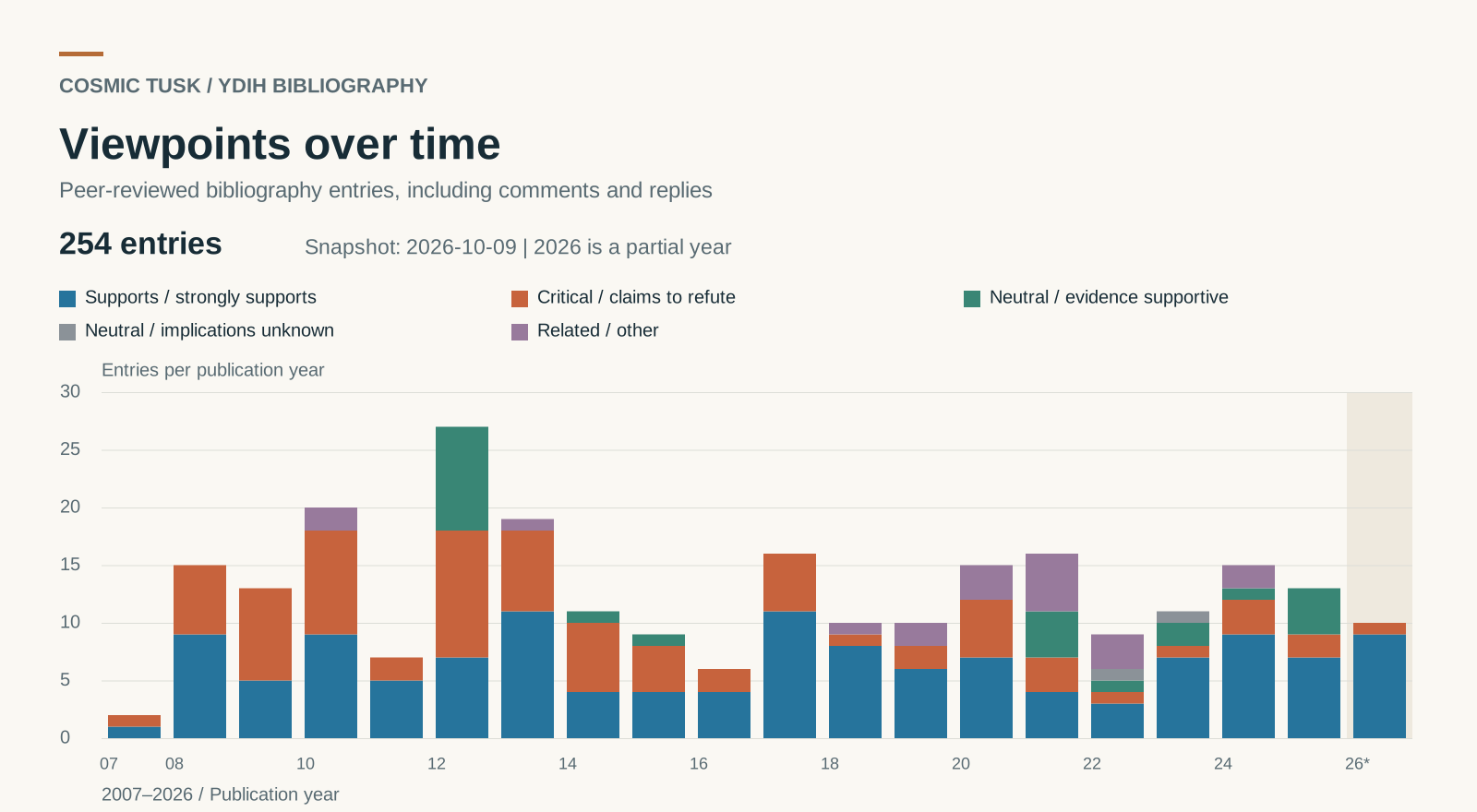
Publication cadence

Annual entries, with comments and replies shown separately.

03

Beyond peer-reviewed literature

Annual activity in the non-peer-reviewed collection.

Scroll sideways to explore the graphic. Close to return to The Bib.

362 references · 0 selected

Page 1 of 15
About the classifications

Assessments follow Marc Young and George Howard’s editorial classifications. “Neutral; evidence supports” describes their reading of evidence in a paper with a neutral stated position. Hiawatha and Taurid labels identify related research topics.

Each reference retains the workbook’s notes, source worksheet, and publication-status description. Citation exports preserve the source author names.

The original spreadsheet

Marc’s workbook remains the master source. Use Excel’s File menu to download a copy. If Microsoft’s embedded viewer does not load, open the workbook directly.

Original spreadsheet viewer

Follow the research

Explore the evidence

Ten categories. Different measurements. Questions worth following.

01 · Identify the material02 · Establish the timing03 · Test the explanation

Select a row to open its reading list. Compare what researchers examine with what must be established to connect an observation to an impact.

Selected reading from The Bib, grouped by evidence and research question.

Material evidenceParticles, chemistry & isotopes

MicrospherulesWhat researchers examineParticle abundance, composition, and microscopic textures.The question to testDo the particles record an impact, and can the findings be reproduced with comparable sampling methods?4 papers

Follow the research · Microspherules

Melt glassWhat researchers examineGlass chemistry, mineral inclusions, and evidence of melting.The question to testWhat heating process produced the glass, and which observations distinguish competing explanations?3 papers
Carbon-rich particlesWhat researchers examineCarbon spherules, glass-like carbon, soot, PAHs, and fullerenes.The question to testAre the materials correctly identified, and does their origin distinguish an impact from other processes?3 papers

Follow the research · Carbon-rich particles

NanodiamondsWhat researchers examineCrystal structure, particle identification, and abundance through a sediment sequence.The question to testAre the grains diamonds, are they concentrated at the boundary, and is their presence diagnostic of an impact?4 papers

Follow the research · Nanodiamonds

IridiumWhat researchers examineElement concentrations relative to background sediment and other platinum-group elements.The question to testIs an enrichment reproducible, and does the full geochemical pattern identify its source?4 papers
PlatinumWhat researchers examinePlatinum peaks in ice and sediments, and their position relative to dated layers.The question to testDo the peaks represent the same event, and what separates extraterrestrial, volcanic, and local sources?4 papers
OsmiumWhat researchers examineOsmium isotope ratios together with highly siderophile element abundances.The question to testWhich source or mixture fits the measurements, and how does sampling resolution affect the interpretation?4 papers
Other elements & isotopesWhat researchers examineNi, Co, Cr, Th, rare-earth elements, and ¹⁴C, ¹⁰Be, ²⁶Al.The question to testWhat is each measurement testing? These different tracers require separate source and background models.3 papers

Environmental changeProposed effects and their chronology

Biomass burningWhat researchers examineCharcoal, soot, and other burning indicators across dated records.The question to testWas burning unusually widespread and synchronous, and what establishes the proposed cause?5 papers
Extinctions & human populationsWhat researchers examineFossil occurrences, archaeological records, and estimates of population change.The question to testWhen and where did changes occur, and how can a causal connection be distinguished from coincidence?4 papers

Literature review videos

Sixteen installments from Dr. Martin Sweatman’s literature-review series. Select a thumbnail to watch on YouTube.

Help improve The Bib

Found a missing paper, correction, or broken link? Include the title, DOI or publication URL, and a short explanation when you contact George Howard or Marc through your existing correspondence.

Please credit Marc Young, George Howard, and the Cosmic Tusk when reusing the bibliography. Explore William I. Thompson III’s historical catastrophism bibliography for additional earlier literature.